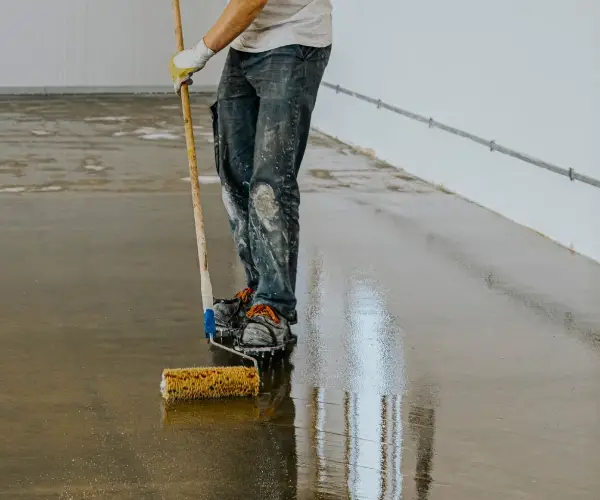
To make a long story short, ours adheres better because:
We have the best primer among our competitors
It's an epoxy primer – epoxy bonds excellently to concrete, while urethanes (polyaspartic, polyurea) do not
It doesn't cure extra fast, and here's why that's critical for adhesion:
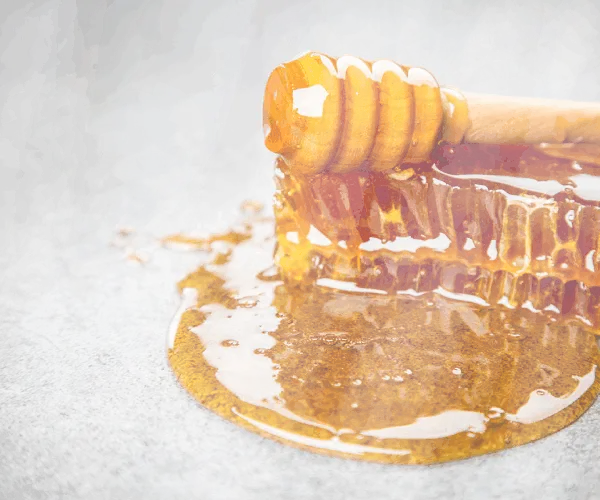
The Honey Analogy (Why Slow Curing = Better Bonding)
Think of honey soaking into concrete. It’s slow, right? Epoxy works the same way – it soaks into concrete slowly, then gets hard.
Here’s the key: Turning into gel is the first step in the hardening process. Once epoxy gels, it stops soaking into concrete.
For a strong bond, we want our primer to penetrate deep into the concrete, to grab it and hold on tight. It’s like the difference between trying to grab a bowling ball with a wet hand (slippery, no grip) and grabbing a basketball with a dry hand (secure grip).
The Honey Analogy (Why Slow Curing = Better Bonding)
Low viscosity
Penetrates concrete pores easily
Longer gel time
84 minutes at 73°F vs. competitors' fast-cure systems
Surface tolerant
Works even on damp surfaces
Cross-cut adhesion
5A rating (5 = best, 0 = worst)
Why Not Use a One-Day Polyurea Instead?
There’s massive hype around “one-day floors” in the industry. Here’s our position on one-day floors:
Epoxy takes almost 90 minutes to gel, giving it time to seep into concrete and form a strong molecular bond.
Polyureas that cure in an hour begin to gel in just minutes – there’s no time for penetration. If the coating doesn’t soak into the concrete, it won’t have a strong bond and you’ll have a higher chance of peeling.
You have to ask yourself: Do you want it done fast, or do you want it to last?
What matters more to you – one less day of construction, or a floor that lasts decades?
Epoxy vs. Urethanes
Epoxy is tried and true, and not a trendy shortcut like polyurea or polyaspartic (both forms of urethane).
Urethanes struggle to bond to concrete. That’s why so many floors fail early, peeling up from the bottom.
The science: Concrete is alkaline and porous. Epoxy’s chemical structure allows it to create covalent bonds with concrete’s calcium hydroxide. Urethanes can’t form these same bonds – they rely on mechanical grip, which just doesn’t last.
But urethanes do have their place. That’s why we use polyaspartic as a topcoat. (Not for bonding, but for performance.) It adds chemical resistance, scratch protection, and hot-tire durability.
You get the best of both worlds: epoxy where it matters most, urethane where it performs best.
Our Solution
A layered epoxy-urethane system that gives you:
Strong foundation
Epoxy’s superior adhesion chemically bonds to concrete for long-term durability.
Enhanced performance
Urethane adds chemical, scratch, and hot-tire resistance for real-world resilience.
Longevity
A floor that outlasts budget systems like acrylic and polyurea, and looks good doing it.
The Technical Details That Matter
Our Hi-Grip Primer achieves:
Deep penetration into the concrete substrate that strengthens weak concrete
An outgassing barrier that prevents blistering and delamination
Adhesion on dry, damp, or wet concrete to deliver weather-tolerant performance
Foundation for trowelable systems that support mortar screeds and high-build applications
Why surface tolerance matters
Most primers fail in high humidity or on damp surfaces. Ours bonds in up to 80% relative humidity, so you’re not waiting around for perfect conditions.
The Bottom Line
Most floor failures start with poor adhesion.
While fast-cure systems get rushed in and sit on top of concrete, we take the time to bond at the molecular level.
The result? A floor that doesn’t just stick – it becomes part of your concrete.
Reference: Not Diluted With Water and Dirt → Learn why our 100% solids formulation contributes to superior adhesion.